MVP in 6–8 weeks: what to build, what to cut, and how to launch
Product
MVP in 6–8 weeks: what to build, what to cut, and how to launch
How to scope and build a minimum viable product in 6–8 weeks: finding the core loop, cutting features, a week-by-week plan, the tech choices that save time, and what to measure after launch.
In short
How to scope and build a minimum viable product in 6–8 weeks: finding the core loop, cutting features, a week-by-week plan, the tech choices that save time, and what to measure after launch.
An MVP can be built in 6–8 weeks when it does one thing: let a real user complete the core loop of the product, from the problem to the result, with nothing extra around it. The time goes into that loop, sign-in, basic billing if you charge from day one, and a simple landing page. Everything else waits until real users show you what they need.
Most MVPs that take six months are not minimum. They include admin panels, settings, integrations and edge cases nobody has asked for yet. This guide shows how to cut a product idea down to something you can launch in two months, and what the weeks look like.
Find the core loop
The core loop is the shortest path from "I have this problem" to "the product solved it". Write it as three to five steps:
Ecomtoro: describe a product idea → AI researches demand, competition and margin → get a verdict
A booking tool: pick a service → choose a time → get a confirmation
A client portal: log in → see order status → download documents
If a feature is not part of the loop, it is not in the MVP. You can read how we built the loop first in how we built Ecomtoro.
What to cut
Usually in the MVP
Usually cut from the MVP
The core loop, done well
Secondary workflows
Sign up and log in
Teams, roles and permissions beyond one or two
Basic billing (if charging)
Coupons, complex plans, invoicing rules
Essential emails
Notification preferences and digests
Simple admin via database or a basic screen
A full admin panel
Analytics events for the loop
Custom reports and dashboards
One platform (usually web)
Native mobile apps
Manual work behind the scenes
Automation of rare tasks
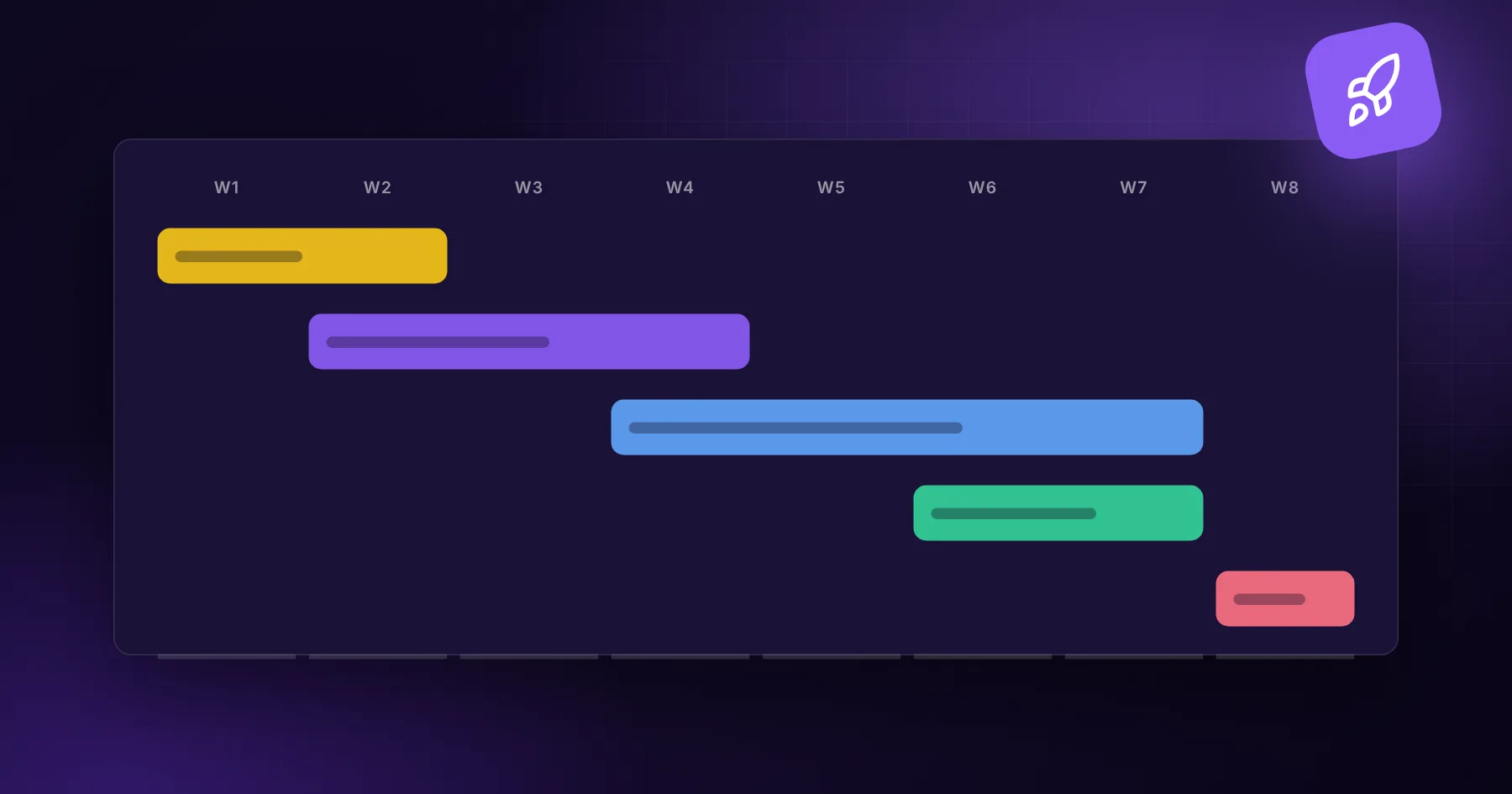
A week-by-week plan
Week
Focus
Output
1
Discovery
Core loop, users, success metric, scope list
2
Design
Clickable prototype of the loop, tested with 3–5 users
3
Foundations
Project set-up, data model, auth, deploy pipeline, first screens
4
Core loop
The main flow working end to end on staging
5
Core loop
Edge cases that matter, emails, billing
6
A simpler product can launch after week 6. A product with AI, heavy integrations or payments may need all eight weeks.
Tech choices that save time
One full-stack framework such as Next.js for the landing page and the app
A managed database such as PostgreSQL, with a clear schema from day one
Hosted auth and payments (for example Auth.js or a hosted provider, and Stripe) instead of building them
A component library so screens look consistent without custom design for each one
Background jobs only if the loop needs them, such as AI processing or imports
Error monitoring and analytics from the first deploy
These choices are not exotic; that is the point. An MVP should spend its risk on the product idea, not on technology.
Who needs to be involved
A decision owner on your side who can say yes or no within a day
3–10 real users willing to try the prototype and the beta
A small build team: typically one designer and one or two developers
If you cannot find ten people willing to try the MVP for free, that is important information before you spend money on building it.
What to measure after launch
Decide before launch what "working" means. Useful MVP metrics:
Activation: how many sign-ups complete the core loop once
Repeat use: how many come back and do it again within a week or a month
Conversion to paid: if you charge, how many pay after the trial
Qualitative feedback: what users try to do that the product cannot do yet
Plan the next release from this data, not from the original wish list.
Common MVP mistakes
Building for every user type at once. Pick one audience first.
Polishing before validating. Animations and themes can wait.
Building an admin panel first. Use the database or a minimal screen.
Waiting for "complete". An MVP that never launches teaches nothing.
Not talking to users. Analytics show what; conversations show why.
Yes, if the scope is limited to the core loop. Many successful products launched with less than their founders first planned.
What does an MVP cost?
It depends on the loop, integrations and whether AI or payments are involved. A focused 6–8 week MVP is a fraction of the cost of a full product, which is why it is the safer first step.
Should an MVP be a mobile app?
Usually not. A responsive web app reaches users on every device and is faster to change. Build a mobile app when the data shows people need it.
What happens after the MVP?
You measure, talk to users, and plan the next release. If the product works, the MVP code becomes the foundation for the full product.